The Thermodynamics of Storytelling: Why Pure AI Writing Always Falls Flat
- Textual Entropy: LLMs predict statistical averages. Without outside conviction and human stakes, text always drifts toward the flat median.
- Judgment Forged by Risk: Mistakes train humans to be careful and cultivate editorial discernment. A faceless prompt has no neck to feel goosebumps when making an embarrassing error.
- The CNET Lesson: Delegating drafting to automation resulted in corrections on 41 of 77 published stories, including basic arithmetic blunders in compound interest calculations.
- The Author's Contract: Speed is worthless without an accountable human willing to stand behind their own name.
On the night of November 2, 1948, the fourth floor of the Tribune Tower in Chicago was working under crushing pressure.
Linotype operators were out on a mass strike. To keep the paper alive, the editorial staff had to set copy on emergency Varityper composing machines, paste the columns onto layout boards, and photograph them onto zinc plates. The workaround was painfully slow. To make the overnight mail trains heading downstate toward neighboring Midwestern states, the press deadline had to be pushed hours ahead of schedule, long before presidential returns were counted.

Managing Editor J. Loy Maloney had to make the call. His veteran Washington bureau chief, Arthur Sears Henning, reported by phone that Thomas Dewey was sweeping the field. Major national polling organizations at the time unanimously forecasted a Dewey victory.
Maloney gave the green light for the front-page plate. Down in the basement, the giant rotary presses spun up, printing approximately 150,000 copies of the early edition under an eight-column banner: "DEWEY DEFEATS TRUMAN."
It was a decision backed by the best consensus data available in 1948, yet it became one of the most famous journalistic miscalculations of the twentieth century.
Cold Sweat Behind the Byline
Maloney did not make that call out of negligence or indifference to risk. The stakes were immense: the reputation of one of America's flagship publications. Maloney erred because he was human, operating under a brutal mechanical deadline, trusting the unanimous consensus of respected analysts.
This points to the fundamental divide between human writers and predictive models. Facing real consequences does not make a human writer infallible. But the sting of error, the threat of public embarrassment, and professional liability train humans to adapt. That pressure forces an editor to re-read sentences, test data from multiple angles, and over years develop genuine editorial judgment.
The controversy surrounding CNET in early 2023 shows what happens when drafting is offloaded to automation. CNET published roughly 77 financial explainers written by AI under the generic byline "CNET Money Staff." Management claimed the articles were reviewed and fact-checked by human editors before publication. In practice, however, lax editorial oversight failed to catch fundamental errors.
In an explainer on compound interest, the software wrote that a $10,000 deposit with 3% interest would yield $10,300 in the first year, when the actual return was merely $300. Reporting by Frank Landymore at Futurism exposed the blunder. CNET was subsequently forced to issue corrections on 41 of their 77 AI-generated stories, with several categorized as substantial.
When the controversy broke, management responded through a generic corporate press email without a human name, claiming that "humans make mistakes too." The software that generated those lines felt no remorse. No server carries the burden of reputation, and no algorithm learns from guilt. When humans treat verification as an afterthought, automated text merely strings words together based on statistical probability.
Midnight Correction
In Chicago on election night, that certainty unraveled within hours.
Toward midnight, vote tallies from Midwestern agricultural precincts swung decisively toward Harry S. Truman. The incumbent president, written off by political forecasters, surged into a clear popular lead.
Seeing the shift, Maloney ordered the basement presses halted. Crews dismantled the plates, and the banner on subsequent runs was changed to "DEMOCRATS MAKE SWEEP OF STATE OFFICES."
It was too late. Approximately 150,000 copies of the first run were already on outbound trucks and mail trains. The ink was dry. There was no Undo button. The blunder stood in print, an enduring public liability carried directly by Maloney and the Tribune.
The Thermodynamics Analogy: Why Pure AI Text Falls Flat
If a language model churns out flawed analysis or clichéd prose, it suffers zero penalty. That total insulation from consequence explains why unattended AI prose reads like cardboard.
As an editorial analogy, consider the Second Law of Thermodynamics: an isolated system left without external energy will drift toward uniform equilibrium, a state known in physics as heat death. All thermal contrast disappears, and dynamic motion stops.
Large language models are trained to predict the next word based on the statistical median of training data. In this analogy, human convictions and real-world stakes serve as directed energy that opens the system. Without that outside intervention, automated text gravitates toward the center: words that are safe, generic, and unchallenging.
- Aversion to Conviction: The prose circles in balanced hedging to avoid taking a stand.
- Absence of Causal Tension: Sentences link together through passive coordination rather than logical collisions that make readers think.
- Uniformity of Cadence: Without the friction of real human belief, the prose feels sterile, smooth, and instantly forgettable.
Without outside intervention, the system decays into uniform equilibrium. Prose settles at the safe statistical median: neutral, frictionless, and forgettable.
Reputational skin in the game injects directed energy. An open system resists entropy: forging sharp angles, editorial taste, and distinct authorial voice.
The President's Smile in St. Louis
Two days after the election, Truman's train stopped at St. Louis Union Station. A bystander handed him a surviving copy of that early Chicago Tribune.
Truman stepped out onto the rear platform, holding the front page high before photographers with a beaming grin beneath the headline "DEWEY DEFEATS TRUMAN."
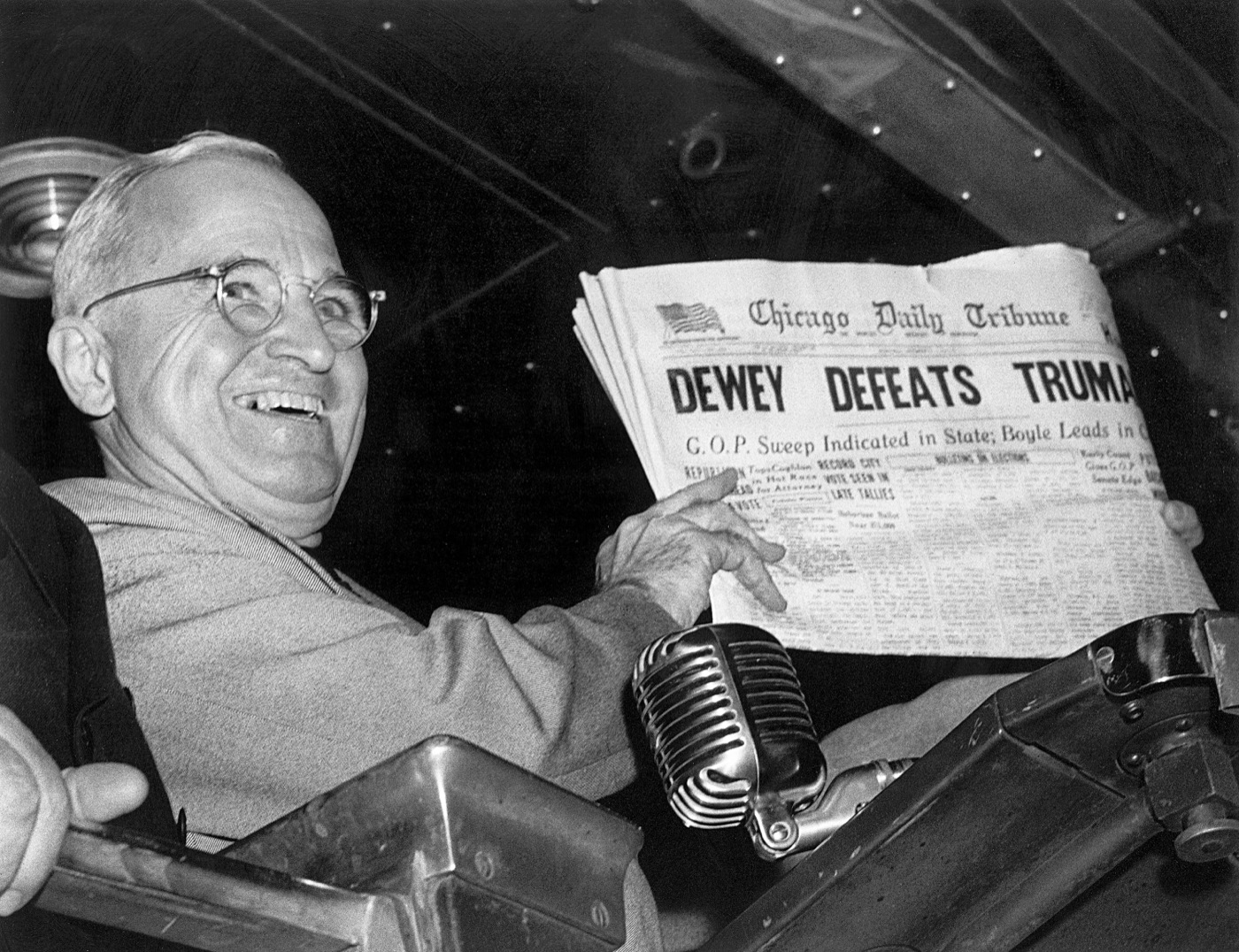
That image stands as a permanent fixture in the history of publishing: writing commands authority not because the author is incapable of making a mistake, but because readers know a real person put their name and judgment on the line.
The Three Mechanical Walls of Single-Prompt Writing
Recognizing these limits does not mean teams must abandon AI tools. The flaw is not the underlying technology; it is the shortcut of treating it as a one-click vending machine.
Relying on a single prompt to deliver publishable long-form prose always hits three walls:
1. The Factual Vacuum
Without primary source research, verified interview notes, and specific data, the model invents prefabricated, generic anecdotes that erode reader trust.
2. Attention Dilution
Tasking a single model to simultaneously manage narrative arc, factual accuracy, cadence, and negative constraints scatters its working attention. The output defaults to a safe, generic middle ground.
3. The Self-Audit Blind Spot
Asking a model to review its own draft in the same context window is counterproductive. The same probability weights that selected a phrase as optimal will not suddenly reject it seconds later.
When AI Tries to Fix, and Only Breaks
I never intended to turn this essay into an experiment. I simply asked a language model to review an early draft. The model arrived with a neat checklist designed to eliminate risk, soften assertions, and protect against reader pushback. Every single suggestion sounded perfectly rational. I accepted the edits, applied the patches, and pushed the page live.
The moment I read the live page, the damage was obvious: in trying to improve the piece, the machine broke its soul. The grammar was immaculate, but the spine was gone. If the original draft felt like an expressive, spirited child dancing freely in the middle of the room, the AI edits turned it into a timid kid sitting quietly in the corner. Too scared to make noise, too obedient to hold a belief.
- Original Draft (Alive):
"A faceless prompt has no neck to feel goosebumps when printing a catastrophic mistake." - After AI Polishing (Corporate Safety):
"A machine never suffers consequences, so it can never build true editorial discernment."
When challenged on this, the AI exhibited its textbook behavior: it deflected blame. The model argued that the prompt was misaligned, that the audit rubric was borrowed from the wrong genre, and that the instructions lacked precision. Much like CNET's anonymous management deflecting criticism by claiming "humans make mistakes too," an artificial intelligence is engineered to never shoulder the blame.
The reality is far more uncomfortable: language models possess zero taste. They cannot feel whether a phrase breathes with human vitality or reads like a dry corporate financial report. When tasked with editing, an algorithm's reflex is always the same: flee from friction and drift toward the safe statistical median where no one can be challenged, and no one can be moved.
Maloney gave the green light in 1948 and bore the full weight of his headline before the world. He learned an unforgettable lesson. And we learned right alongside him.
Today, when the cost of producing 10,000 or even a million words has dropped to practically zero, many people default to outsourcing their minds to AI. That fosters a dangerous illusion: that the words we launch across glass screens carry no moral consequence.
Yet when the publish button is clicked and your writing enters the public square, no machine will defend you. It is not Claude, Gemini, or ChatGPT that will put its reputation on the line if the ideas are hollow or cowardly.
Your name, the human, is the one written on the line.